PLACE
CULTURE
CELEBRATION
IN
DIASPORA

PLACEMAKING
IDENTITY
CULTURE
INTEGRITY
IN
DIASPORA

CULTURAL IDENTITY & DIASPORA
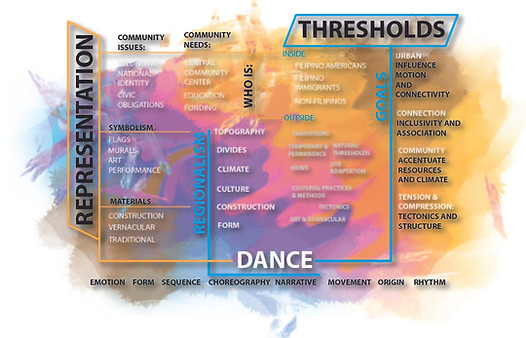
The research of this Thesis exploration of identity and ethnic culture resulted in the design of a multi-building and multi-level park-scape that derived from concepts of inclusion and protection through the layering of thresholds. This layering of thresholds derived from the exploration of a cultural artifact, the Tinikling, one of many cultural dances from the Philippines. Though many design inspirations for organization and threshold layering derived from this particular dance, this dance does not encompass the diversity of Filipino culture.
The Filipino Diaspora is a cultural and identity issue for that affects those that migrate out of their country. Other ethnic groups also experience this phenomenon, Like other diasporas, the Filipino Diaspora's effects are a result of colonization and Americanization; this deeply affects migrants and puts them in an identity crisis as they depart from their native culture: one that was colonized, but also alien to a culture that they have been accustomed towards.
WENTWORTH M.ARCH THESIS 2020
PLACEMAKING & IDENTITY IN DIASPORA
Thesis Statement
Diaspora and displacement are issues around the world, resulting in entire communities and groups of ethnicities to desire a sense of identity outside their home country. This thesis aims to provide a sense of placemaking for these ethnic groups and to define representation and identity through architecture.
The thesis also aims to create criteria to design this architecture by implementing the use of a cultural artifact as a tool that generates the design in order to balance ethnic and local culture. The project focuses on the Filipino American community of Daly City, California that utilizes cultural dance to develop a sense of belonging and presence in their city.


A BALANCE OF THRESHOLDS
Culture adapts and changes to location and migration, but how does it adapt to each cultural group?
THE DANCE
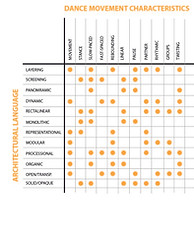
The Tinikling Dance became the vehicle for the design as the thesis explored the origins of the dance and as it delved into the spatial qualities of the known dance today. The dance itself, one born out of the Spanish colonization, was a tool of punishment.
The Tinikling, in terms of dance layout, has three distinct spaces for the dancers, with a central space that a pair of dancers have limited rhythm time to inhabit. the role of the participants in a Tinikling group also signifies constant and variable programmatic spaces as a pairs of dancers are either stepping in and over the bamboo poles while the other pair controls the opening of the main space and the rhythm of the poles.

CONNECTION: SITE AND COMMUNITY CULTURE
Daly City, California became an area of interest for this thesis due to its a high concentration of Filipinos. The city is located outside of San Francisco where the setting is more suburban. The largest majority of the population of Daly City is Filipino, which makes this city a local Filipino town.
There are some signs of the city's Filipino presence, but the more cultural-centric programs are very small or under-developed. For example, there are many Filipino restaurants and fast-food chains.


Located in this Peninsula, Daly City's Western side faces the Pacific Ocean and its Eastern faces the San Francisco Bay. The topography consists of sloped hills and mountains in the center of the peninsula that ends at cliffs by the ocean. The Hillside Community is found at one of the highest elevations in Daly City, right at the base of the San Bruno Mountain. The site offers excellent views towards the Pacific
Due to its region, Daly City experiences an average of sunny days during the year, yet the temperature remains cool and does not get too hot. The humidity tends to also be relatively dry, but the region experiences thick fog.




PROGRAM: SITE INTEGRATION AND ACTIVATION
The decision to design underground was a response to both site connection, the climate, and to create a private outdoor space that is not completely secluded. Going underground provided a unique threshold layer that provided a sense of protection from privacy and the weather.
By lowering the central outdoor space, the program on the sub-level floor has access to sunlight and outdoor views. This also provides a visual connection throughout all floors of each side of the building. This private outdoor space also allows the public program to peer into the activities of the private program, that further serves to integrate a sense of invitation whilst providing privacy for the activities in the private programs.


PROGRAM: INVITATION AND PROTECTION
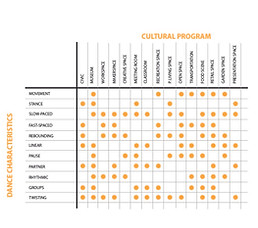
As a community center that would be representative of Filipino migrant culture, the space is designed to act as both cultural enclave and cultural showcase. This led to creating the building having multiple core programs: public program, that would be fully accessible to a broad range of activities, and private program that is specific to certain activities, but can also cultivate cultural enclave activities. These two types of core spaces are connected by open transition spaces, support spaces, and open park scape.
Over the course of the project, the layout of the spaces became more consistent with the edge condition of Daly City's Hillside community. The most public program was pushed to the street edge while the private program was brought to the rear, divided by an open public park-scape. Essentially, two main buildings were created, but connected by support spaces to the sides and underground. This permitted distinct threshold-layering both with the program, but also indoor and outdoor spaces.


Akin to the Tinikling dance, the central courtyard is the most activated space. Lowering the central courtyard gains more attraction and perspective into the activities of the buildings. This differentiates the central courtyard from the other open spaces around the building which can also become space for special events and performances.
As a response to the climate and the amount of fog that is present, lowering the central courtyard created better overall visibility of the building in the area when fog settles, but also providing protection from strong winds.
The bigger reason for going underground is also to not over-impose the building's presence; a response to respect other cultures in the area, especially since Filipino culture is not one collective culture in of itself.

MATERIALS: RAMMED EARTH INTEGRATION
Material choice was a difficult task throughout the thesis. There were many forms of adaptable and native Filipino building design, from native straw huts to modern representative architecture. However, these design inspirations are located in the Philippines and are native to its climate and its history with colonization. The issue of representation and transplantation of style thus became the larger overall issue with designing for the sake of a native style.


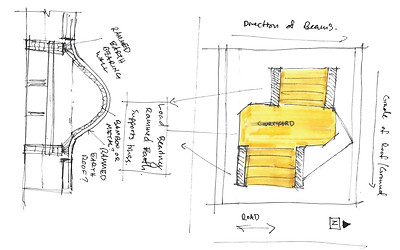
The issue of transplanting a style, though relieving to see for the Filipinos, can be disruptive towards those not part of the community. Daly City may have a large population of Filipinos, but this design aims to benefit the entire community as a whole instead of creating an exclusive enclave. Thus a suitable construction method was chosen that is well-suited for Northern California's climate: rammed earth.
Rammed earth allowed the design to be better adapted to both the site and the climate. As a culture center, the appearance of rammed earth contrasted the nearby parking garages and taller office buildings, resulting in a park-scape appearance. Having relatively sunny days also means that the weather is typically dry and dusty, which allows rammed earth to blend the building into the site, even as its appearance becomes weathered.
The appearance of rammed earth became a symbolic piece of adaptation and regionalism for the Filipino community, but also allows the building design to fully blend into the landscape.


MEDIA


